Whether you’re a business owner or a marketer, SEO is crucial for establishing an online presence. If you’ve been asking questions like, how do I optimize a website for search engines? What is SEO exactly? Then this guide is for you.
In this detailed SEO step by step tutorial for beginners, you will not only understand the core concepts but will also be exposed to a well-defined SEO strategy which will make ranking on Google a piece of cake. This beginner level guide provides essential SEO techniques, practical insights, and example case studies for 2025.
What is SEO in Digital Marketing?
SEO is shorthand for Search Engine Optimization and involves improving a particular website to ensure it achieves a higher ranking on the results page of search engines such as Google and Bing, through paid or organic marketing.
To put it simply, SEO in digital marketing means analyzing your target market, determining what they are searching for, and optimizing your website so that it ranks higher than competitors.
What Does SEO Mean in Marketing?
In contrast to paid ads, which incur costs on a daily (or more often) basis, SEO (Search Engine Optimization) is a free marketing technique that aims to increase traffic and visibility to organization on search engines. However, SEO, like any other free techniques, requires dedicated effort and excellent strategy if it is to bear results.
The SEO Workflow Process: A Complete Overview
Here’s a simplified breakdown of the SEO workflow process:
- Keyword Research
- On-Page Optimization
- Technical SEO
- Content Creation
- Link Building
- Performance Monitoring & Analytics
Step 1: Keyword Research – How to Use SEO Keywords
The term “keyword research” blends into a single term used in the singular sense of a foundation of SEO, however it is comprised out of two words as in keyword and research, which is crucial for understanding search volume. It answers the question: What are people typing into Google to find what I offer?
How to Use SEO Keywords:
- Research Using tools like Google Keyword Planner, Ahrefs, SEMrush, or Ubersuggest.
- Target a mix of short-tail (e.g., “SEO”) and long-tail keywords (e.g., “how to do SEO for website step by step”).
- Focus on search intent—understand whether the user wants to buy, learn, or compare in order to enhance search engine rankings.
Tools to Try:
- Google Trends
- AnswerThePublic
- Keywords Everywhere (browser extension)
Step 2: On-Page SEO Optimization Steps
This is where the individual pages of your website are optimized for target keywords.
Key On-Page SEO Elements:
- Title Tag: Place the primary keyword at the beginning.
- Meta Description: Keep it under 160 characters with a call to action.
- Header Tags (H1, H2, H3…): Organize content for readability.
- URL Structure: Use hyphens instead of underscores and keep it short.
- Internal Linking: These connect to other pages on your website.
- Image Optimization: Use alt text and compress files.
Example:
If your keyword is “how do I SEO my website”, your title could be:
“How Do I SEO My Website? 10 Proven Steps That Work”
Step 3: Technical SEO – Make Google Love Your Site
Even if your content is top-notch, having poor site architecture may restrict search engines from crawling and indexing your pages as intended.
Technical SEO Checklist:
- Mobile-friendliness: Check your site’s mobile friendliness using Google’s tool.
- Site Speed: Image optimization, code minification, and caching boost speed.
- SSL Certificate: Transition your site from HTTP to HTTPS.
- Sitemap: Submit sitemap to Google Search Console.
- Robots.txt: Ensure it’s not blocking important pages.
- Structured Data (Schema Markup): Customize more captions for rich snippets.
Step 4: Content Creation – The Heart of SEO
Your content should answer the searcher’s intent better than any other website on the internet. This is the focal point of your SEO tutorial approach.
Content SEO Tips:
- Write long-form content between 1000–2500 words and brace it with substantial information.
- Integrate keywords from LSI (Latent Semantic Indexing) seamlessly.
- Include images, videos, infographics, and charts.
- Utilize bullet points and short definitive paragraphs to make it easily skimmed.
Step 5: Link Building – Earn Authority & Trust
Search engines use links as votes of confidence. Therefore, the more links you have, the more credibility you earn towards authority.
Link Building Strategies:
- Guest Posting
- Skyscraper Technique
- Broken Link Outreach
- Directory Submissions
- Internal Linking Strategy
Backlinks from authoritative sites signal Google that your content is trustworthy and relevant.
Step 6: Monitor, Analyze, Improve
Like everything else, SEO can’t be done in just one initial action and expect it to run forever, regular analysis fosters perfect growth and long run success.
Tools for Monitoring:
- Google Search Console – Helps with tracking growing and declining keywords along with tracking where your content is being indexed.
- Google Analytics – Helps with tracking the amount of traffic received, the bounce rate, and how many people actually converted.
- Ahrefs / SEMrush – Helps with monitoring the backlinks being given to you, keyword, and site audit.
SEO Tutorial Summary: SEO Step by Step in 2025
| Step | Description |
| 1. Keyword Research | Find what your audience is searching for. |
| 2. On-Page SEO | Optimize titles, content, URLs, and structure. |
| 3. Technical SEO | Improve speed, security, mobile, and crawling. |
| 4. Content Creation | Provide value-rich content targeting intent. |
| 5. Link Building | Earn quality backlinks from relevant websites. |
| 6. Monitor & Improve | Use tools to track, analyze, and adapt strategy. |
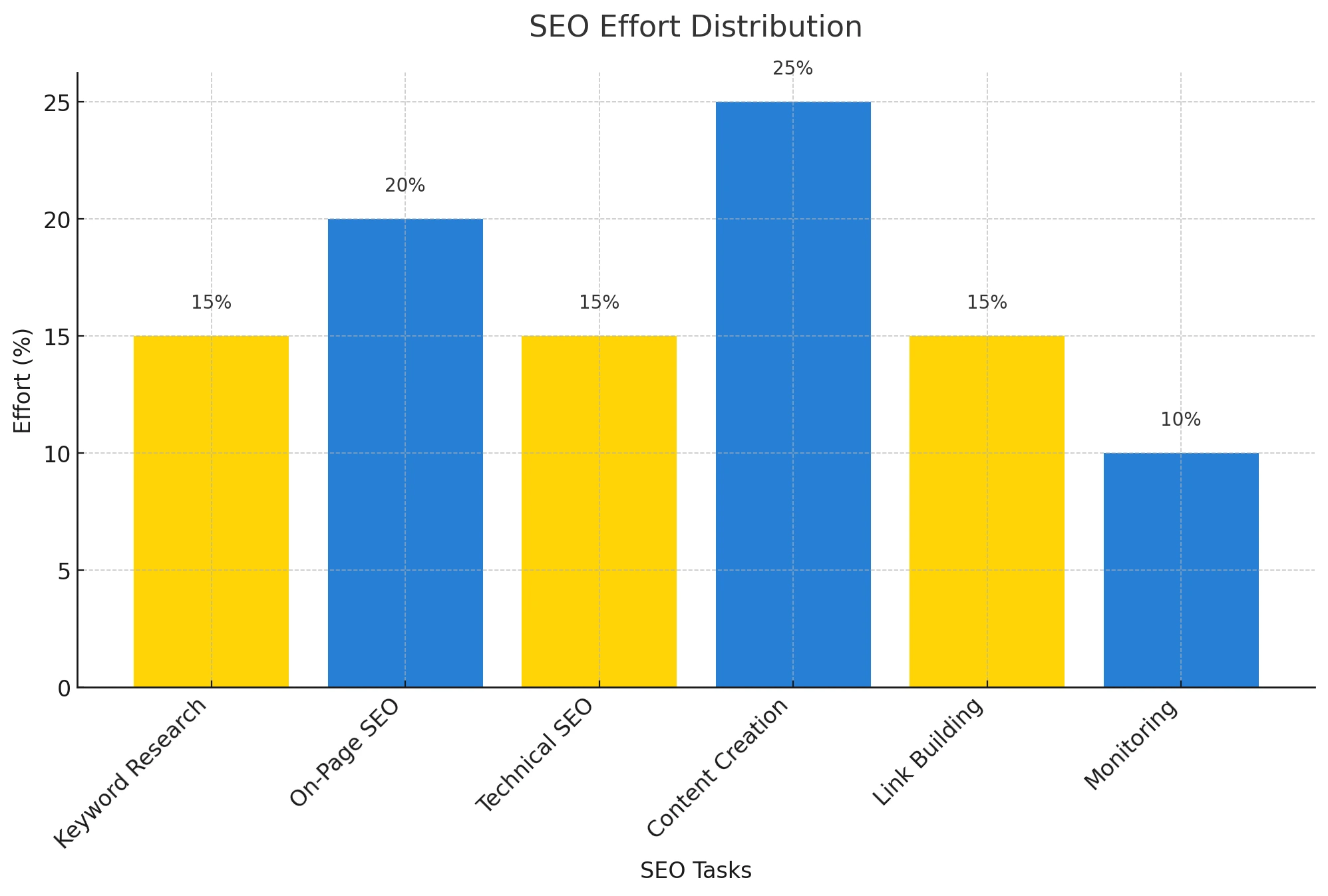
Graph: Here’s a useful visualization that show SEO effort distribution
SEO for Beginners: FAQs Answered
- What are the 4 stages of SEO?
The four main stages of SEO are:
- Technical SEO – Sets up the website to be crawled and indexed by search engines.
- On-Page SEO – Involves optimizing content, keywords, title tags, and internal links.
- Off-Page SEO – Deals with building links and other external authority metrics.
- Content Strategy & Analytics – Continuous monitoring, updating, and content creation based on performance.
These stages outline the SEO process and must be executed in a logical order.
- How does SEO work?
SEO works by aligning your website with how search engines like Google determine relevance and quality. That includes but not limited to:
- Performing keyword research and selection.
- Producing relevant, high-quality content.
- Boosting website speed and user experience.
- Acquiring backlinks from other credible sites.
When a search engine deems your site relevant, trustable and optimized, it will rank it better in the results pages (SERPs). They will do this based on a set of predefined heuristics. This is the strive behind SEO – tutorial strategies for search engine optimization.
- Is SEO good for beginners?
Absolutely! SEO is ideal for beginners because, at the start, it can be learned without needing sophisticated technical skills. Using an appropriate SEO guide for beginners, someone without any background knowledge can learn to perform SEO on a website and achieve tangible results within a few months.
It’s best to begin with simple tasks like on-page SEO, content creation, keyword analysis, and later progress to technical aspects like SEO link building.
- What is the first step to start SEO?
The most important aspect to initiate an SEO strategy is keyword research. You cannot plan on optimizing anything until you know what your potential audience is searching for.
With tools like Google Keyword Planner, you can search for phrases with:
- Significant search frequency/ volume
- Reasonable competition, no greater than moderate
- Strong user search intent
This first step sets the stage for all subsequent SEO optimization activities and enables the creation of content that is tailored to user demands.
- How do I SEO my website if I’m just starting out?
Beginners looking to improve the SEO of their websites will benefit from the following steps:
- Identify the relevant keywords for your audience’s searches.
- Optimize title tags and add meta description.
- Add relevant keywords naturally in the body of the content.
- Optimize your website speed and compress images.
- Submit your sitemap in the Google Search Console.
- Gradually create backlinks.
This guide in particular has been formulated to assist beginners with SEO optimization strategies.
- What is SEO and how does it work in digital marketing?
In the context of digital marketing, SEO involves enhancing the presence of your website on search engines without relying on advertisements. To facilitate this, certain areas must be improved, including:
- Quality of content provided
- Structure of the website
- Relativeness of the website as it pertains to queries searched
- Trust and authority signals
SEO is vital because it maintains a consistent stream of traffic to your website while establishing credible authority through brand recognition, all without the expenses associated with sponsored advertisements.
- How long does it take to see results from SEO?
Overall, expect to see clear results in 3 to 6 months with SEO, based on:
- How competitive your industry is
- The current condition of your site
- The effectiveness of your SEO strategy
SEO, unlike ads, is a continuously valid investment. The traffic obtained from it persists well after your efforts have been put forth, especially when there is consistent optimization and content refreshment.
- What tools do I need to start with SEO?
These are fundamental tools required to embark on your step by step journey with SEO:
- Google Search Console – For monitoring and improving site indexing.
- Google Analytics – To analyze the traffic.
- Yoast SEO (for WordPress) – For on-page SEO assistance.
- Ahrefs / SEMrush – For keyword and backlink analysis.
- Ubersuggest – Beginner-friendly keyword tool.
These tools assist with the entire workflow of SEO: from research all the way to reporting.
- How do I use SEO keywords in my content?
Successfully incorporating SEO keywords include the following:
- Placing the keywords in the title, H1, and in the first 100 words
- Employing LSI keywords (related terms) with the content
- Not overusing the keyword phrase
- Creating text for readers, not bots
As an example, instead of repeating “how to do SEO of website” over and over, you could use, “SEO optimization steps” or “how do I SEO my website.”
- Can I do SEO myself, or should I hire an expert?
Absolutely, you can do SEO by yourself. This can be made easier with quality resources such as this SEO tutorial. Many newbies manage their SEO effectively by following a clear guide and using free or inexpensive tools.
But if you need to achieve results quickly, then hiring an SEO expert or agency is a great way to make fast progress. Be sure to think about what your goals are, how much money you have, and how much time you can dedicate into the project.
Final Thoughts
Remember that SEO isn’t about trying to get the upper hand; it’s about comprehensively analyzing what users need and assisting them in locating it. If you adhere to this guide and SEO process workflow, you will notice tangible improvements in your incoming traffic and rankings.
This SEO tutorial for beginners is perfect for any entrepreneur, blogger, marketer, or student as it contains all the essential foundational knowledge to get started.
We design high-performing websites and deliver SEO that gets results. Trusted by businesses across the UK, US, AU, and CA.
www.theseocrunch.com | theseocrunch@gmail.com