Landing pages play a critical role in digital marketing and online business growth. Whether businesses are running Google Ads, Facebook campaigns, email marketing promotions, or SEO campaigns, the ultimate goal of a landing page is to convert visitors into leads or customers. However, many businesses invest heavily in traffic generation but fail to optimize their landing pages properly. As a result, they lose valuable conversions, leads, and revenue.
A landing page is a standalone web page specifically designed to encourage users to take a desired action. That action may include:
• Filling out a contact form
• Signing up for a newsletter
• Downloading an ebook
• Booking a consultation
• Requesting a quote
• Purchasing a product
• Starting a free trial
Improving landing page conversions involves optimizing design, content, usability, trust, speed, and user experience to persuade more visitors to complete the intended action.
Modern conversion rate optimization (CRO) focuses heavily on user behavior, search intent, psychology, and performance metrics. Businesses that optimize their landing pages effectively can increase conversions without spending additional money on advertising.
Understanding Landing Page Conversions
A landing page conversion occurs when a visitor completes a specific action on the page. Conversion rates are measured by dividing the number of conversions by the total number of visitors.
Example Conversion Formula
| Metric | Example |
| Total Visitors | 1,000 |
| Total Conversions | 100 |
| Conversion Rate | 10% |
A higher conversion rate means the landing page is successfully persuading users to take action.
Common Landing Page Goals
| Landing Page Type | Main Goal |
| Lead Generation | Collect user information |
| Product Sales | Sell products or services |
| Webinar Registration | Increase event signups |
| Free Trial Pages | Encourage software testing |
| Appointment Booking | Generate consultations |
Different landing pages require different optimization strategies depending on the audience and business objective.
Why Landing Page Optimization Is Important
Landing page optimization directly affects marketing performance and profitability.
Benefits of High-Converting Landing Pages
• Higher return on investment (ROI)
• Increased lead generation
• Better user engagement
• Improved customer trust
• Higher sales and revenue
Businesses often spend large budgets on paid advertising. If landing pages perform poorly, businesses waste traffic and marketing spend.
For example:
If two businesses spend the same amount on ads, the business with a better-converting landing page will generate more leads and sales.
Understanding User Intent
One of the most important aspects of improving landing page conversions is understanding user intent.
Visitors arrive on landing pages with expectations based on:
• Search queries
• Advertisements
• Social media promotions
• Email campaigns
If the landing page does not match those expectations, users often leave quickly.
Example of Search Intent Matching
| User Search | Landing Page Focus |
| “best CRM software for startups” | Startup-focused CRM features |
| “free SEO audit tool” | SEO audit signup page |
| “buy wireless headphones online” | Product-focused ecommerce page |
Matching user intent improves relevance and increases conversions.
Write a Clear and Powerful Headline
The headline is usually the first thing users notice.
A strong headline should:
• Clearly explain the offer
• Highlight the value proposition
• Capture user attention quickly
• Match the advertisement or search intent
Weak vs Strong Headlines
| Weak Headline | Strong Headline |
| Welcome to Our Website | Increase Your Leads by 50% With Smart CRM Software |
| Best Marketing Solutions | Affordable SEO Services for Small Businesses |
Visitors often decide within seconds whether to stay on a page. A compelling headline improves engagement immediately.
Improve Landing Page Design and Layout
Visual design significantly impacts user behavior and trust.
Important Design Principles
• Avoid cluttered sections
• Maintain strong visual hierarchy
• Use readable fonts
• Add sufficient white space
• Highlight key CTAs clearly
Modern users expect professional and visually appealing pages. Poor design often reduces trust instantly.
Essential Landing Page Elements
| Element | Purpose |
| Headline | Grabs attention |
| Subheadline | Provides additional clarity |
| Hero Image | Demonstrates value visually |
| CTA Button | Encourages action |
| Trust Signals | Builds credibility |
| Testimonials | Reduces hesitation |
Simple and focused layouts usually perform better than overly complicated designs.
Use Strong Calls-to-Action (CTAs)
The CTA is one of the most important conversion elements.
Effective CTA Best Practices
• Make buttons visually prominent
• Keep CTA text concise
• Place CTAs strategically throughout the page
• Create urgency when appropriate
Examples of High-Converting CTA Text
• Book Your Free Demo
• Download the Free Guide
• Start Your Free Trial
• Claim Your Discount
Weak CTAs like “Submit” or “Click Here” are often less persuasive.
Improve Website Loading Speed
Page speed has a major impact on conversions.
Studies consistently show that slow-loading pages increase bounce rates and reduce user satisfaction.
Why Speed Matters
| Slow Page Impact | Result |
| Delayed loading | Higher bounce rates |
| Poor user experience | Lower trust |
| Mobile frustration | Reduced conversions |
| Slow checkout process | Abandoned purchases |
Ways to Improve Speed
• Use browser caching
• Minimize CSS and JavaScript
• Use fast web hosting
• Implement content delivery networks (CDNs)
Fast-loading pages improve both SEO and user experience.
Optimize for Mobile Devices
A large percentage of website traffic now comes from smartphones and tablets.
If landing pages are not mobile-friendly, businesses risk losing significant conversions.
Mobile Optimization Best Practices
• Large clickable buttons
• Fast loading speed
• Easy form completion
• Readable text without zooming
Google also prioritizes mobile-friendly websites through mobile-first indexing.
Build Trust and Credibility
Users are more likely to convert when they trust the business.
Trust Signals That Improve Conversions
• Case studies
• Online reviews
• Security badges
• Industry certifications
• Money-back guarantees
• Contact information
Example of Trust-Building Elements
| Trust Signal | Purpose |
| SSL Certificate | Website security |
| Google Reviews | Social proof |
| Client Logos | Brand credibility |
| Awards | Industry authority |
Trust signals reduce user hesitation and increase confidence.
Use High-Quality Visual Content
Images and videos help users understand products or services more effectively.
Best Practices for Visual Content
• Avoid low-quality stock photos
• Add explainer videos
• Use product demonstrations
• Optimize image sizes for speed
Video content especially improves engagement and conversion rates.
For example:
A software demo video can explain features much faster than large text blocks.
Simplify Forms
Long and complicated forms often reduce conversions.
Form Optimization Tips
• Use simple field labels
• Reduce unnecessary steps
• Enable autofill features
• Use multi-step forms if needed
Example of Good Form Practices
| Poor Form | Better Form |
| 12 required fields | 3–5 essential fields |
| Complex instructions | Simple labels |
| Long registration process | Quick signup |
Shorter forms generally produce higher conversion rates.
Improve Content Readability
Landing page content should be easy to scan and understand quickly.
Readability Best Practices
• Add bullet points
• Use descriptive headings
• Highlight important benefits
• Avoid technical jargon when unnecessary
Users rarely read every word on a landing page. Clear formatting improves content consumption.
Use A/B Testing for Optimization
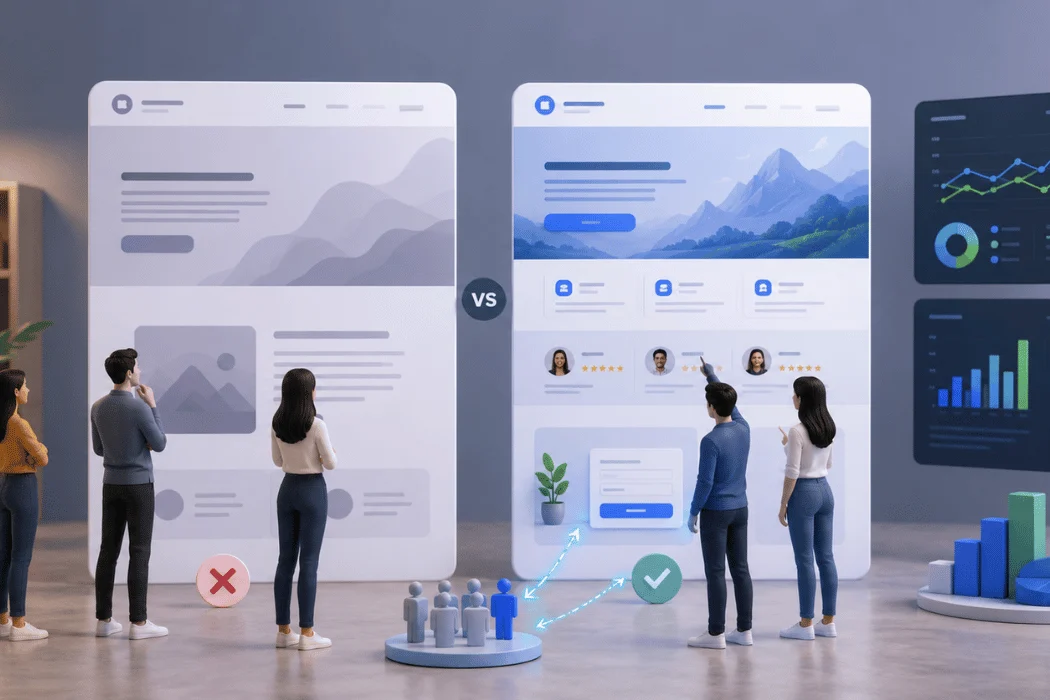
A/B testing compares two versions of a landing page to determine which performs better.
Elements Commonly Tested
• CTA buttons
• Images
• Form length
• Colors
• Layout design
• Pricing displays
Benefits of A/B Testing
| Benefit | Impact |
| Better user understanding | Improved decisions |
| Higher conversions | Increased revenue |
| Reduced assumptions | Data-driven optimization |
Even small changes can significantly affect conversion rates.
Reduce Distractions
Landing pages should focus users on one primary action.
Common Distractions to Avoid
• Multiple CTAs with different goals
• Excessive animations
• Popups that interrupt users
• Irrelevant content sections
A focused landing page improves clarity and conversion performance.
Leverage Social Proof
People trust recommendations and feedback from other users.
Types of Social Proof
• Video testimonials
• User ratings
• Case studies
• Social media mentions
• Client success stories
Social proof reassures users that others have benefited from the product or service.
Track Key Landing Page Metrics
Monitoring performance data helps businesses identify weaknesses and opportunities.
Important Metrics to Track
| Metric | Purpose |
| Conversion Rate | Measures effectiveness |
| Bounce Rate | Indicates user engagement |
| Time on Page | Shows content interest |
| Click-Through Rate | Measures CTA performance |
| Form Completion Rate | Tracks lead generation success |
Analytics tools like Google Analytics and Hotjar help businesses analyze user behavior.
Common Landing Page Mistakes
Many landing pages fail because of avoidable errors.
Common Problems
• Weak headlines
• Poor mobile optimization
• Lack of trust signals
• Too much text clutter
• Confusing navigation
• Weak CTA placement
Fixing these issues often improves conversions quickly.
Future Trends in Landing Page Optimization
Landing pages continue evolving with user expectations and technology.
Emerging Trends
• Interactive landing page experiences
• Voice search optimization
• Video-first landing pages
• Advanced behavioral targeting
Businesses that adapt to these trends will likely maintain higher conversion rates in the future.
Frequently Asked Questions
What is a landing page conversion?
A landing page conversion happens when a visitor completes a desired action such as signing up, making a purchase, or filling out a form.
Why are landing page conversions important?
Higher conversion rates help businesses generate more leads and sales without increasing marketing costs.
How can page speed affect conversions?
Slow-loading pages increase bounce rates and frustrate users, which can lower conversions significantly.
What is the best CTA for landing pages?
The best CTA is clear, action-oriented, and aligned with user intent, such as Start Free Trial or Get a Free Quote.
How does A/B testing improve landing pages?
A/B testing identifies which headlines, layouts, or CTA buttons perform better and improve conversions based on real user data.
Conclusion
Improving landing page conversions is essential for maximizing marketing performance and increasing business revenue. A well-optimized landing page combines strong headlines, fast loading speed, mobile-friendly design, trust signals, persuasive CTAs, and clear user-focused content to guide visitors toward taking action.
Businesses that continuously test, analyze, and improve their landing pages often achieve higher lead generation and better ROI from their digital marketing campaigns. By understanding user intent and focusing on user experience, companies can create landing pages that not only attract visitors but successfully convert them into loyal customers.
www.theseocrunch.com | theseocrunch@gmail.com